Few events in ancient history appear with as much universal consistency as the Great Flood. More than 270 cultures across every inhabited continent preserve a memory of a cataclysm in which judgment fell, waters rose and a remnant survived. These accounts—the Chinese Shu Jing, the Sumerian Eridu Genesis, the Akkadian Atrahasis, the Indian tale of Manu, the Greek account of Deucalion, the Aztec story of Nata and Nena, the Mesopotamian Epic of Gilgamesh and many more—share remarkable agreement on the core details. A world-engulfing flood. A righteous or chosen family. A vessel, survival and rebirth.
When you find this level of consistency among civilizations separated by oceans, languages, religions and millennia, you are no longer looking at mythology. You are looking at collective memory. And this universal memory aligns precisely with the historical narrative preserved in the Scriptures of the Old Testament. The fact that every culture on Earth remembers judgment by water suggests strongly that their ancestors experienced the same event, and that Noah’s descendants carried that memory across the post-Flood world. This article cannot begin to address the full sweep of evidences—textual, spiritual, genetic, theological, archaeological and cultural—which support the truth of the Flood. For that broader picture, readers should turn to my book The Earth as It Was, which examines those topics in depth.
Here, we turn specifically to the geological and geographical evidences, which remain some of the most striking and difficult for secular science to ignore.
Before we move into those evidences, it’s worth noting that the Flood left traces not only in rocks but also in lasting physical oddities: submerged cities like the Black Sea settlement, anomalous artifacts like the London Hammer, giant human footprints, apparent ark remains in eastern Turkey and strange water-driven scarring across continents. Yet the Word of God is truth. The Bible is not validated by geology—geology is validated when it aligns with the Word of God. And in the case of the Flood, it aligns spectacularly.
We now consider several categories of hard geological evidence that speak unmistakably of global catastrophe.
One of the clearest contradictions to the standard geological column is the existence of polystrate fossils—trees or plants fossilized upright through multiple layers of strata. According to evolutionary theory, each layer of sediment represents a vast age of slow deposition, sometimes millions of years per inch. And yet a tree, which decays in a matter of decades, stands perfectly preserved through layers allegedly laid down over enormous spans of time.
A tree cannot remain upright, undecayed and intact, while “millions of years” of sediment slowly accumulate around it. The only scenario that makes sense is a rapid, catastrophic burial—something precisely like a global flood which sweeps layers of sediment across vast regions in days or weeks rather than eons. Polystrate fossils are testimony that the geologic column is not a slow, evolutionary process, but a product of catastrophic judgment.
Another glaring contradiction to evolutionary chronology is the presence of mixed fossil assemblages—animal and human footprints found in the same sedimentary layers. The famous trackways at Glen Rose, Texas and at locations in Massachusetts, Tennessee and elsewhere contain dinosaur prints alongside what appear to be human footprints, some of them giant and six-toed.
Secular scientists are quick to deny or reinterpret these findings because they understand what it means: if humans and dinosaurs left footprints in the same mud, the evolutionary timetable collapses completely. These trackways demonstrate not only coexistence but rapid fossilization, another sign of sudden watery burial rather than slow geological change.
Satellite imagery has revealed something astonishing: immense water-cut channels spanning entire continents. The Sahara Desert alone exhibits colossal flow patterns running westward toward the Atlantic. These are not small riverbeds but continent-wide striations carved by unimaginable volumes of fast-moving water.
Secular explanations often resort to winds or “long-vanished rivers,” but the sheer scale, directionality and erosive force reflected in these patterns points overwhelmingly to a catastrophic drainage event. The presence of silt plumes off the coast of Africa—specifically where these flow lines empty into the ocean—confirms that vast quantities of sediment were ripped from the land and deposited at sea.
Such global-scale water movement is exactly what we would expect as the Flood waters receded, draining off continents into the newly deepened ocean basins formed by tectonic rupture.
The Gulf of America is filled with enormous banks of silt originating from as far north as Canada. Thick beds of sediment extend far into the basin, forming one of the largest underwater deposits in the world. The pattern is identical to what we would observe if a continent sloughed off billions of tons of soil in a rapid, high-energy event.
Sediment does not naturally migrate thousands of miles and settle neatly along continental margins without the kind of massive hydraulic force only a global flood could generate.
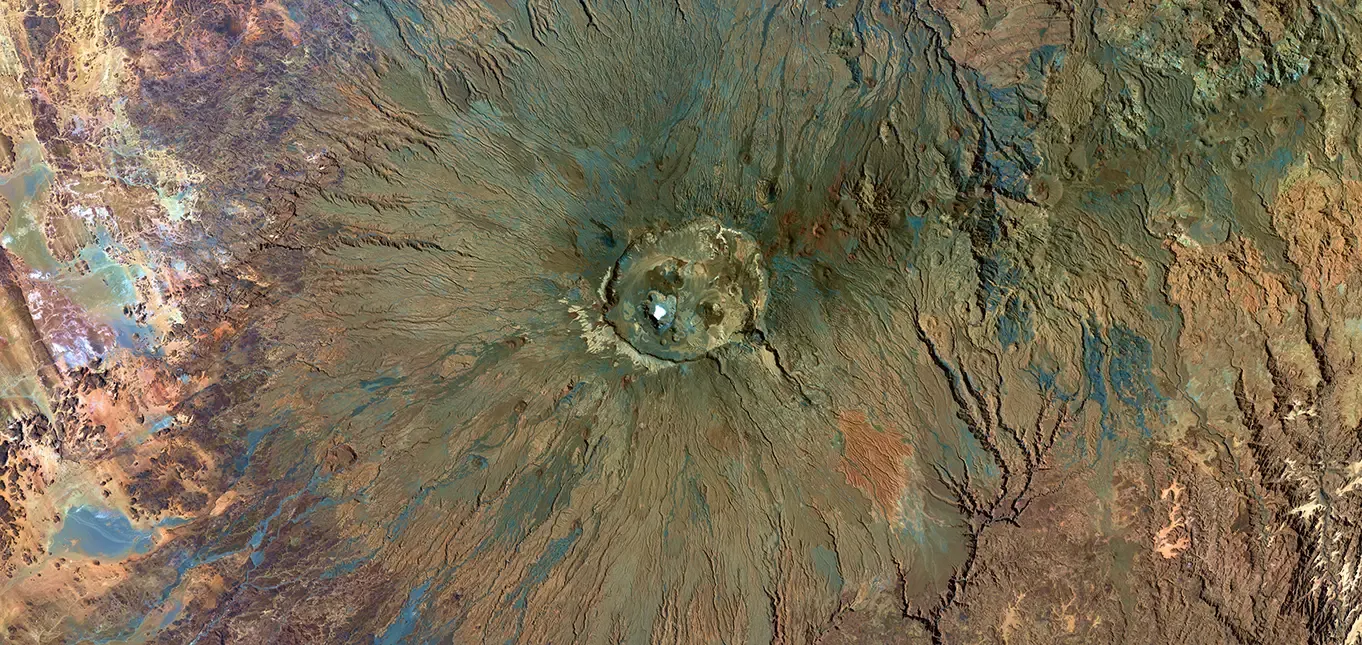
In places like Emi Koussi in northern Africa, satellite photographs reveal deep channels carved directly through hardened lava flows which mainstream geology dates to around 12,000 years old. For such channels to exist, water must have flowed with incredible force after the lava had hardened.
This places a global-scale flood or mega-drainage event after that lava eruption, meaning relatively recently in Earth’s history. Catastrophic water-driven erosion slicing through basaltic lava is consistent with the receding waters phase of Noah’s Flood.
Genesis describes the primary source of the Flood waters not as atmospheric rain but as the bursting forth of the “fountains of the great deep.” Until recently, secular science dismissed such subterranean waters as mythology. Now, however, geologists acknowledge the existence of massive underground reservoirs—waters held within mantle rock in quantities rivaling the oceans themselves.
This discovery stunned the scientific community because it aligns perfectly with Scripture’s description of the Earth being “founded upon the seas.” The water was already there, beneath our feet, just as the Bible says. The Flood was not merely the result of a heavy storm; it was a planet-wide geological rupture releasing unimaginable subterranean pressure.
That rupture left scars – fault lines, rifts and tectonic boundaries – that remain visible today.
In 1998, a meteorite crashed near Monahans, Texas. Inside it were water and salt crystals – something that baffled NASA researchers. The most coherent explanation is that this rock originated on Earth and was violently ejected into space. A global crustal rupture, such as the breaking open of the fountains of the deep, could easily blast debris into orbit.
This supports the biblical model of a catastrophic tectonic upheaval, where water, rock and steam were propelled upward with explosive force. Far from a calm rise in sea levels, the Flood was a geological apocalypse.
Geological evidence also intersects with anthropological mystery. Across regions like Track Rock Gap in the Appalachians, fossilized footprints – including giant six-toed impressions – appear alongside animal tracks, embedded in stone. These impressions, said to be thousands of years old, defy evolutionary expectations but align with the biblical worldview that includes pre-Flood giants, rapid burial and Earth-shaking catastrophe.
These preserved prints speak of a world in upheaval. Creatures fled. Mud churned. Sediments engulfed everything in their path. Only rapid hardening, not slow sedimentation, could freeze such impressions in time.
This article has only touched on a handful of geological evidences supporting the Flood. But the Flood left far more than geological signatures. It left spiritual, cultural, linguistic and historical fingerprints—records that are explored far more extensively in my book Earth as It Was. This survey is only a small window into a global event that shaped the entire post-Flood world.
We shouldn’t discuss the geological record without confronting the modern religion that attempts to explain it away: evolution. Darwinism is not science. It is a belief system rooted in naturalistic assumptions, built on circular reasoning and held together by faith—faith that random mutations create complexity, faith that life emerges from nonlife, faith that the past must always resemble the present and faith that the geological record shows slow change rather than catastrophic upheaval.
But faith in evolution is not rewarded by evidence. It is contradicted by it.
The rocks show rapid burial, not slow accumulation. The fossils show sudden death, not gradual transformation. The continents show catastrophic movement, not gentle drift. The genome shows deliberate design, not accidental assembly.
The world’s cultures show unified memory, not independent myths.
To believe in evolution is to place trust not in observation but in speculation. To believe in the Flood is to accept what both Scripture and geology proclaim with one voice: that the world was once drowned in judgment, reshaped by cataclysm and repopulated by the family of a righteous man with a pure bloodline.
Where evolution asks us to trust theories built upon ever-shifting sand, the Word of God invites us to stand on bedrock.
And the rocks themselves agree.